Stakeholder Solidarity & the Silence Within Business-As-Usual | Reflections from World Beautiful Business Forum 2026

My talk and reflections from the World Beautiful Business Forum, Athens
I'm fresh off the back of the World Beautiful Business Forum in Athens last week, the first ever conference I've attended that centres humanity and the more-than-human as a prerequisite for what 'beautiful' business is and could be.
It was the first time I've been in a room with many people who all understand what's at stake in terms of how business interacts with the broader world it inhabits and depends on: the workers, the resources, the living systems. It was just really affirming to be somewhere that another version of doing business feels not just possible but necessary.
Dr Bayo Akomolafe gave the closing talk, and true to form, he resisted putting a bow on it. He talked about the falsehood of the word "about" — how when we speak about something, we position ourselves as if we're on the outside looking in, as if we're separate from it. Whether we're talking about business, the climate, or the economy, we speak as though we're not part of it. But we are. That stuck with me. Because even the phrase "business world" implies that business is separate from the world. It isn't.
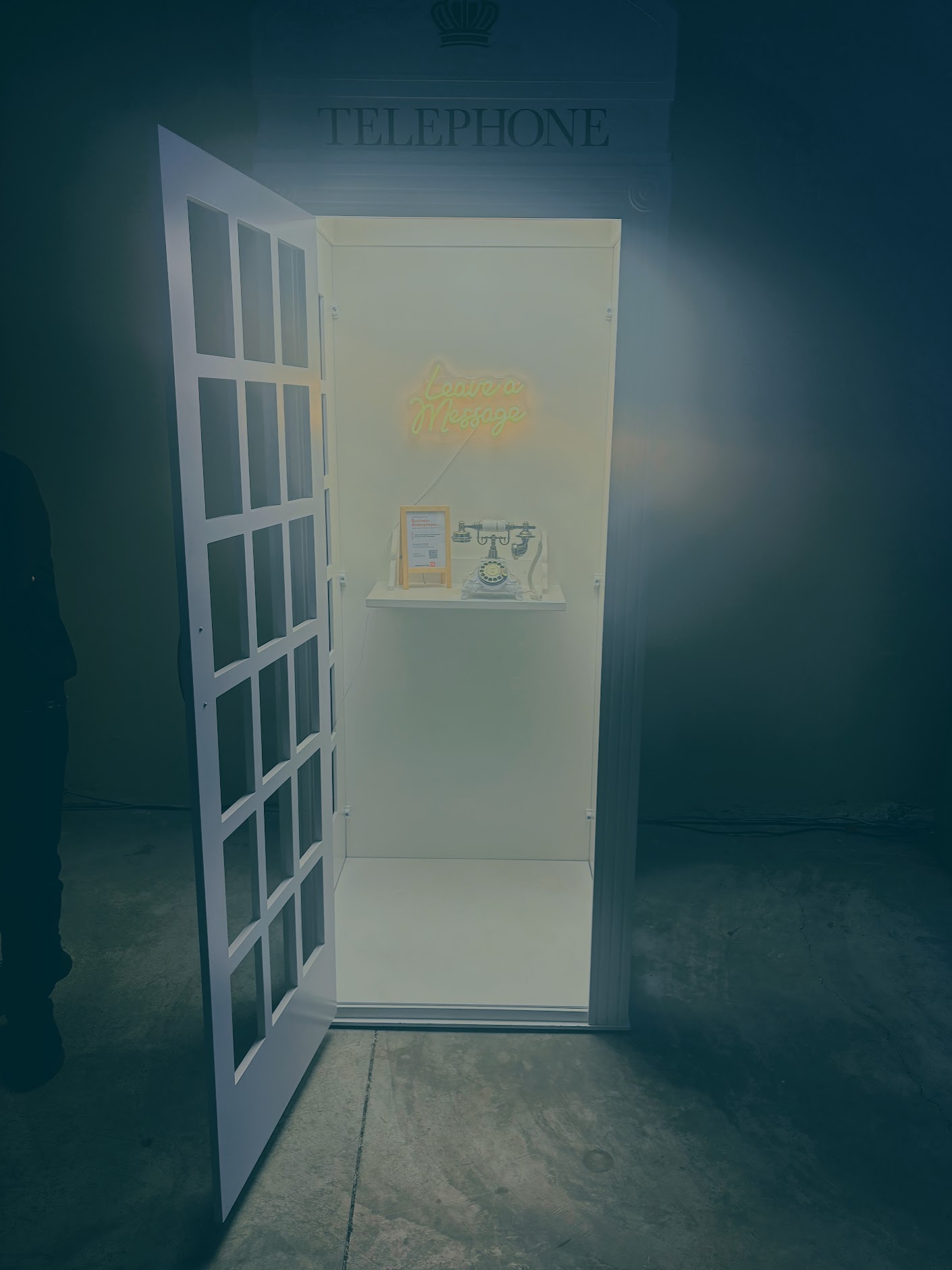
I also launched my first physical research installation at the old stock exchange in Athens — the Business Anonymous booth — where I asked people to share anonymously what change the business world needs that we don't talk about. Two phrases from participants have stayed with me: interdependence literacy and energy blindness — the idea, explored so well by Nate Hagens in The Great Simplification, that business operates as if it isn't materially dependent on the systems it inhabits. I'll be sharing the full findings from that installation very soon.
Last week, on stage at the Old Stock Exchange as part of the Ministry of Regeneration track, I gave a short talk about corporate governance norms and how they structurally, undemocratically, silence stakeholders. I'm sharing a rough outline below because it might be useful to anyone who has felt that same cognitive dissonance of being inside business and knowing, innately, that things could be so different.
The silence I couldn't explain at the time
Seven years ago, I was working for one of the biggest tech companies in the world. From my desk, I could hear chants forming outside. I peered three floors down and saw youth climate activists mounted on the revolving entrance, a banner up, protesting the company's funding of climate-denying organisations. On the other side of the building, mothers were nursing their children outside in protest — a feed-in — against the impact of my employer's activities on future generations.
My colleagues and I looked at each other. None of us really knew what to say. And I didn't realise it at the time, but that silence was structurally guaranteed.
160,000 global employees. Not a single seat on the board. When thousands of shareholders put forward motions for a sustainability committee, it was vetoed. When a proposal to end the dual-class voting structure came forward, it was vetoed too. Because two billionaire co-founders held majority voting power. Two voices silencing thousands.
I supported XR privately. Professionally, I kept hitting a brick wall whenever I tried to weave social impact into my role — because what got rewarded was whatever drove top-line revenue. A friend of mine in Big Tech recently had to stack-rank every task she did by revenue potential. Everything in the bottom half — the work that gave her job meaning, the tasks that added human value — was cut.
Eventually, after my second maternity leave, I left. But I kept asking the same question: what do people like me, corporate insiders of for-profit institutions, genuinely believe about the role of business at this pivotal moment?

What the research revealed
So I got back in touch with my professor from my behavioural science masters, Dr Dario Krpan, and together with Dr Frédéric Basso, we designed a study to find out. We surveyed more than 400 managers at UK for-profit companies. And the results were striking.
92% believe business leaders must adhere to doughnut economy principles: meeting social needs, respecting planetary limits, ensuring fair outcomes for all.
86% support specific post-growth business practices, such as reinvesting surplus into the mission or more democratic decision-making.
But here's what I hadn't fully anticipated: only 53% believe their peers support these things too. That gap is pluralistic ignorance. When you believe that moving beyond profit is a divisive position — that you're in the minority — you don't speak up. You assume conflict. And that silence preserves a status quo that the majority never actually agreed to.
This is happening at exactly the moment when the stakes couldn't be higher. The same big tech giants that made bold climate commitments a decade ago are now ripping them up to win the AI race, investing heavily in natural gas and fossil fuel infrastructure that will lock in emissions we cannot afford. Distilled's research on Google and the growing trend of behind-the-meter data centres make this very concrete. It is far from regenerative. It is extractive.
From knowing better to doing better
So how do we get from knowing better to doing better? I've been thinking a lot about two frameworks.
Relationship to profit
The first is the Doughnut Design for Business tool from Kate Raworth's Doughnut Economics Action Lab. One of its central questions is: what is your company actually for?

The second is Jennifer Hinton's five post-growth business dimensions. Her foundational insight — the choice she believes determines everything else downstream — is a company's relationship to profit. And that relationship isn't just cultural or strategic. It's a legal constraint.
Is your company legally structured to drive profit as its primary purpose? Or do you have a mission that is legally locked, where any surplus is used to serve that mission rather than to maximise returns? Because if you're a well-meaning, mission-led company that is still legally structured for profit, your mission will always be optional. When the pressure comes, and it always does, profit wins. The legal architecture decides.

Governance
The same applies to governance. Who gets a say in decisions? And who gets the final say? Even if you consult widely, if a board of ten people make the ultimate call, is that truly democratic? Probably not.
I spoke about this in Athens — the birthplace of the idea that people should have a say in decisions that affect them. And as Dr Luke Kemp's research on societal collapse shows, hierarchical structures that concentrate power in the hands of a few become fragile. They stop getting feedback from the broader collective. They sow the seeds of their own demise.
But there are precedents. Multi-stakeholder cooperatives in Canada. Germany's legal requirement that companies above a certain size must have 50% employee representation on their supervisory board. And House of Hackney, which legally appointed a director representing Mother Nature and future generations. This is not utopia. These are real structural choices that already exist.
What I found when I looked at 90+ companies attending World Beautiful Business Forum
I also ran the 90+ companies attending WBBF through my own interpretation of Hinton's five post-growth dimensions, using publicly obtainable information, to ask: is this company structurally compatible with a regenerative future?
Only 14% made it into the top tier — what I called stewarding — genuinely mission-locked, not just in what they say but in how they're structured. And every single company in the lowest tier was a publicly listed company.
Does your business give impacted stakeholders a say? Or even simply a process to share their perspectives? If you're an employee, do you have any form of participatory process to help steer its future democratically? Who is on the board?
For me personally, I only discovered after leaving Google that not a single seat on the board represented the 160,000+ global workforce. Two billionaire co-founders held majority voting power. Two voices silencing thousands. This isn't just Google. It's how most big business is structured by design.
The question isn't whether change is possible
The structures already exist. The majority already want it. The only thing missing is the willingness to say so out loud.
That's what the Business Anonymous booth was for. And the findings from those conversations, what people felt safe enough to say only when no one was watching, will be shared soon.
If you don't want to miss it, subscribe to the Moral Footprint Substack and listen to the upcoming episode wherever you get your podcasts, or sign up to my newsletter,
If any of this resonated, I'd love to know — drop a comment below or find me on LinkedIn.

Read more
Other articles you may want to read.

Beyond Corporate Power at Ethical Consumer Conference 2025: Employee Ownership, CICs and the Future of Business
.png)
Introducing WholeLoop Labs: Transforming Products, Professionals & Business Models Beyond Extraction
